
The combined market valuation of top six Sensex companies surged by Rs 26,346 crore last week, with Reliance Industries and HDFC contributing the most to the gains.

Wall Street-correlated stock markets are facing the risk of correction, as Christopher Wood, the global head of equity strategy at Jefferies, conveys to investors in his latest edition of GREED & fear. Rising crude oil prices, which are nearing $100 a barrel (Brent), pose a threat to the global central bank's battle against inflation and have led to a re-evaluation of its exposure to Indian stocks. "The potential for more US Federal Reserve (Fed) rate hikes, combined with the risk that monetary tightening finally bites as regards the economy, remains a risk for Wall Street-correlated world stock markets. "There is also the oil factor. This is why GREED & fear continues to believe the pain trade is down. "Areas in Asia, such as Indian midcaps, which have already done very well, are at obvious risk of some profit-taking," writes Wood.

The office, spread over 52,775 square feet carpet area, in Mumbai's suburban financial centre Bandra Kurla Complex, is on the fourth floor of the building 'Jet Airways Godrej BKC'.

HDFC has joined the interest rate war on housing loans by slashing both variable and fixed rates by 0.5 to 0.75 per cent for individual loans with effect from February 5.\n\n

IndusInd Bank was the top laggard in the Sensex pack, tanking around 7 per cent, followed by Axis Bank, Bajaj Finance, ICICI Bank, NTPC, Tata Steel, ITC and HDFC Bank. On the other hand, Reliance Industries, HCL Tech, Sun Pharma and ONGC were among the gainers.

Market breadth was positive as 1187 stocks advanced for 1643 stocks which declined.

Public sector banks are inefficient, poorly governed and beset by largescale corruption.

ICICI Bank was the top laggard in the Sensex pack, cracking over 5 per cent, followed by Kotak Bank, HUL, HDFC, IndusInd Bank, HDFC Bank and Nestle India. On the other hand, Hero MotoCorp, Bajaj Auto, Maruti, TCS and HCL Tech were among the gainers.

Analysts caution against volatility and recommend buying stocks of companies that are on strong fundamental footing that have been beaten down badly in the recent carnage.

State-owned Life Insurance Corporation of India (LIC), which completes one year of its listing on Tuesday, presents a sorry scorecard as far as its stock market performance goes. Shares of the insurance behemoth are down 40 per cent over their issue price of Rs 949 to Rs 567 apiece. The Sensex, on the other hand, has risen 14 per cent in the past one year.

SBI was the top gainer in the Sensex pack, spurting over 2 per cent, followed by TCS, Tech Mahindra, HUL, Bajaj Finance, Kotak Bank and Titan. On the other hand, IndusInd Bank, PowerGrid, Bharti Airtel, Asian Paints and HDFC Bank were among the laggards.
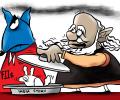
The value of FPIs (Foreign Portfolio Investors) holding in Indian equities reached $738 billion in the three months ended December 2023, marking a surge of 13 per cent from the preceding quarter, driven by the strong performance of the domestic stock market, according to a report by Morningstar. The value of FPIs investment was at $651 billion in the September quarter of the current fiscal. On a year-on-year basis, the value of such investments rose 26 per cent from $584 billion in December 2022.

The Reserve Bank of India (RBI) will stay away from changing key rates - including the reverse repo rate - this fiscal in the backdrop of Omicron. However, it will continue to shape the rate movements through liquidity market operations. Soumya Kanti Ghosh, group chief economic advisor, State Bank of India, said whether Omicron surge or not, there is not going to be any hike this year. However, the central bank may continue to shape rates through market operations.

'India is an equity market with a breadth and depth of companies to invest in.'

Market leaders in this line of business - New India Assurance and Tata AIG - have begun to reassess the premium on risk exposure of their portfolio in the director's and officer's liability business.

At the start of 2016, HDFC Bank, Infosys, ICICI Bank, L&T and Axis Bank were the top five picks of fund managers

HDFC and HUL are the latest entrants in the club

ICICI Bank, HDFC Bank, Infosys, SBI and L&T among fund managers' preferred bets.

'Credit expansion is probably the quickest way to get the economy going again.' 'Easy credit is like a shot of nitro in a race car: In timely, small, quick, doses it can give a tremendous boost but carried to extreme it can destroy the engine,' points out S Muralidharan, former managing director, BNP Paribas.

Urban housing mortgage major HDFC announced that it will cut its lending rates by the end of the week.

The government is planning to extend the electronic modes of tax payment to its own payments platform, Unified Payments Interface (UPI), credit cards of banks, or even a mobile wallet like Paytm.

SBI, the country's largest lender, first announced a rate cut of 0.25 per cent in its home loan rates on Thursday, forcing HDFC, the second biggest home loan financier, to respond.

Market players attribute the rally in small and midcaps to flows from retail investors and domestic institutions.
Challenges abound but innovation is key for new banks inorder to survive.

Yes Bank was the biggest gainer in the Sensex pack, rallying 3.79 per cent. It was followed by PowerGrid, Maruti Suzuki, IndusInd Bank and Axis Bank -- rising up to 2.85 per cent.
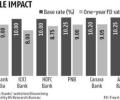
Lending rates in certain segments may be increased; fixed depositors may lock into existing rates.

The government is set to earn an equity dividend of nearly Rs 13,800 crore from the listed public-sector banks (PSBs), all 12 of them, for FY23, up 50 per cent from Rs 9,210 crore in FY22. This will be the highest ever dividend for the government from PSBs. The 12 PSBs in our sample are paying an equity dividend of nearly Rs 21,000 crore for FY23, up 53 per cent from Rs 13,710 crore for FY22.

Fund managers say the recent fall is not going to sustain.
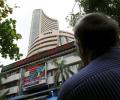
SBI, PNB, Bank of Baroda, Canara Bank, Dena Bank, Central Bank of India ended down 3%-12% each.

Among the Sensex firms, ITC, State Bank of India, Bajaj Finance, NTPC, Power Grid, ICICI Bank, Kotak Mahindra Bank and UltraTech Cement were the major laggards. IndusInd Bank, Tata Consultancy Services, Axis Bank, Mahindra & Mahindra, Tata Motors, HCL Technologies, Asian Paints, Wipro, HDFC and Maruti were among the major gainers.
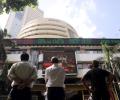
The bulk of the erosion in terms of value took place in India's most-valued firms. For instance, Mukesh Ambani-led Reliance Industries alone has lost Rs 3.8 trillion in m-cap, followed by HDFC Bank, which has seen its value erode by Rs 2.45 trillion and Tata Consultancy Services (TCS), which has lost Rs 1.85 trillion to stand at Rs 6.24 trillion, making it India's most-valued.
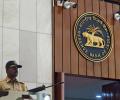
With the Reserve Bank of India's (RBI) extended deadline coming to an end, there will be no automatic recurring payment for various services including recharge and utility bill as the additional factor of authentication (AFA) will become mandatory from Friday. On December 4, RBI had directed all banks including RRBs, NBFCs, and payment gateways that the processing of recurring transactions (domestic or cross-border) using cards or Prepaid Payment Instruments (PPIs) or Unified Payments Interface (UPI) under arrangements/practices not compliant with AFA would not be continued beyond March 31, 2021. As part of risk mitigation measures, RBI announced this step to bolster safety and security of card transactions.

Equity benchmarks Sensex and Nifty ended on a mixed note on Wednesday as the euphoria about the Budget fizzled out, with investors going for profit-taking ahead of the Fed interest rate decision. The 30-share BSE benchmark Sensex climbed 158.18 points or 0.27 per cent to settle at 59,708.08 after it trimmed most of the intra-day gains. During the day, it had zoomed 1,223.54 points or 2 per cent to 60,773.44.
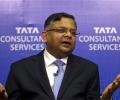
The top line growth for the 500 companies slowed down to 8.7 per cent.

The 30-share Sensex lost 12 points to end at 29,559 and the 50-share Nifty climbed 4 points to close at 8,914.
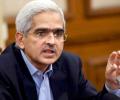
The increasing involvement of Big Tech in the financial system could give rise to concentration risk and there are potential spillovers, which call for closer attention, Reserve Bank of India (RBI) Governor Shaktikanta Das said on Tuesday. "...enormous amounts of consumer data is being generated and leveraged upon by a few entities (the so-called Big Tech) by virtue of their huge customer base. "Such developments raise concerns on concentration risk and potential spillovers as their level of engagement with the financial system strengthens in the years to come," Das said at the Global Fintech Fest 2022.

TCS was the top gainer in the Sensex pack, rising around 4 per cent, followed by ONGC, ICICI Bank, HDFC Bank, Dr Reddy's, HDFC and HCL Tech. NSE Nifty advanced 76.65 points to 14,581.45.

Ajit Mishra, vice president, Research, Religare Broking, answers readers' queries on stocks they own or want to buy. Here are his replies to some of the 'buy, sell, hold, avoid or exit?' e-mails that we have received.
Ajit Mishra, vice president, Research, Religare Broking, answers your queries.
 © 2026 Rediff.com - Advertise with us - Disclaimer - Privacy Policy - Sitemap - Feedback - About us - Terms of use - Grievances